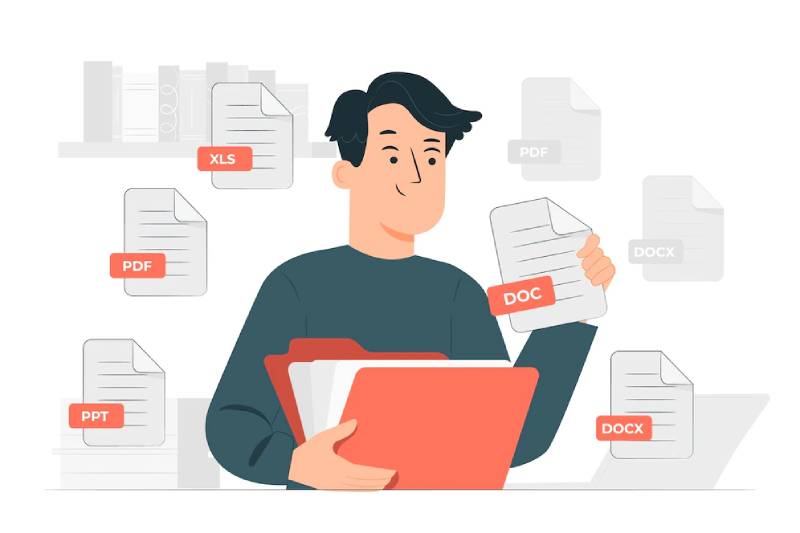
Document processing applications are a type of software that helps you manage your documents and data. There are many different types of document processing applications, but they all have one goal: to make your life easier. With the rise of artificial intelligence and machine learning, document processing applications are getting smarter. These intelligent technologies are revolutionising the way we work with documents, and they’re only going to get more advanced in the years to come. In this blog post, we’ll explore the future of document processing applications and how they’re being enhanced with intelligent technologies. We’ll also discuss some of the benefits of using these applications and how they can help you be more productive.
What Is a Document Processing Application?
A intelligent document processing applications is an application that automates the process of converting unstructured or semi-structured data into a structured format. It does this by extractdocument processing applicationing information from documents and then storing it in a database.
Document processing applications have been around for many years, but their popularity has increased in recent years due to the rise of big data and the need to process large amounts of data quickly and efficiently. There are a number of different document processing applications on the market, each with its own unique features and benefits.
The future of document processing applications looks very promising. With the continued advancement of artificial intelligence and machine learning, these applications are only going to become more intelligent and efficient over time.

the History of Document Processing Applications
The history of document processing applications is one of continual innovation and evolution. Early document processing applications were designed to simply facilitate the creation and editing of text-based documents. However, as computing power and storage capacity increased, so too did the capabilities of document processing applications.
Today, document processing applications are capable of much more than simply creating and editing text documents. They can now also handle a variety of multimedia content, including images, videos, and audio files. In addition, many document processing applications now offer features such as real-time collaboration, version control, and cloud storage.
Looking to the future, it is clear that document processing applications will continue to evolve and become even more powerful and user-friendly. Thanks to advances in artificial intelligence (AI) and machine learning, we can expect document processing applications to become even more intelligent and efficient at handling a wide variety of tasks. So whatever the future holds for document processing applications, one thing is for sure – they will continue to play a vital role in our lives.
the Future of Document Processing Applications
There is no doubt that document processing applications will continue to evolve and become more sophisticated. In the future, we can expect these applications to become more intelligent, with the ability to learn from experience and provide recommendations or even automate tasks. We can also expect document processing applications to become more user-friendly, with an increasing focus on simplifying complex tasks. In addition, as more businesses move towards paperless operations, we can expect document processing applications to play an increasingly important role in managing and storing digital documents.
How Will Intelligent Technologies Shape the Future of Document Processing Applications?
Intelligent technologies are already starting to shape the future of document processing applications. These technologies have the potential to make document processing more efficient and effective, while also reducing the risks associated with human error.
One way that intelligent technologies are being used to improve document processing is through the use of Natural Language Processing (NLP). NLP is a branch of artificial intelligence that deals with the understanding and manipulation of human language. (NLP can used to help automate various tasks related to document processing, such as data extraction, text classification, and entity recognition.
Another way that intelligent technologies are being used to improve document processing is through the use of machine learning. Machine learning is a type of artificial intelligence that allows computers to learn from data without being explicitly programmed. Machine learning can used for tasks such as image recognition, text classification, and predictive modelling.
The use of intelligent technologies is just one way that the future of document processing will be shaped. Other trends, such as the increasing use of mobile devices and the proliferation of cloud-based applications, will also play a role in shaping the future of document processing applications.
the Benefits of Intelligent Technologies in Document Processing Applications
Intelligent technologies are transforming document processing applications, making them more efficient and effective. By automating manual processes and applying artificial intelligence (AI), these applications can improve accuracy, speed, and efficiency while reducing costs.
Here are some of the benefits of intelligent technologies in document processing applications:
- Enhanced accuracy and quality: Intelligent technologies can help reduce errors in document processing by automatically verifying data and correcting mistakes. This can improve the overall accuracy and quality of the processed documents.
- Increased speed and efficiency: Intelligent technologies can automate repetitive tasks and processes in document processing, freeing up users’ time for other tasks. This can lead to increased speed and efficiency in document processing.
- Reduced costs: Automating manual tasks with intelligent technologies can help reduce labor costs associated with document processing. In addition, AI-based solutions can often be provided at a lower cost than traditional solutions.
the Challenges of Implementing Intelligent Technologies in Document Processing Applications
Intelligent technologies are revolutionising document processing applications. However, their implementation is not without challenges. One challenge is that many intelligent technologies are still in their infancy and need to be further developed before they can used in practical applications. Another challenge is that these technologies can be expensive to implement, and may require specialised hardware and software. Finally, there can resistance to change from users who are accustomed to used for traditional document processing applications.
Conclusion
The future of document processing applications looks to be very exciting, with the integration of intelligent technologies that can help us automate many tasks. We are only just beginning to scratch the surface of what these technologies can do and we are sure that there will be many more amazing advances in the years to come. We can't wait to see what the future holds for document processing applications.